Call centre AI software is rapidly reshaping how businesses handle customer interactions. Instead of long queues, repetitive questions, and overwhelmed agents, AI helps you deliver fast, personalised, and consistent support at scale. By understanding how to drive omnichannel support with contact center AI, companies can unify their customer touchpoints seamlessly, while intelligent AI assistance for business operations empowers agents to focus on complex tasks, enhancing both efficiency and satisfaction. When deployed well, it does not replace humans; it empowers them and elevates every customer conversation.
Technology advancements now allow businesses to optimize their operations like never before. Leveraging cloud computing services can improve data handling and support AI-driven customer interactions effectively. Integrating high-performance servers ensures that call centre AI software performs reliably under heavy workloads and scales effortlessly as demand grows. On the marketing side, companies can enhance engagement by using online marketing strategies to reach customers in more targeted ways, while implementing digital marketing campaigns aligns AI support with outreach efforts, improving conversion rates.
Financial planning is equally essential when adopting new technology. Utilizing business finance tools helps track expenses and optimize investments, making it easier to integrate AI without compromising budget. When technology, marketing, and finance strategies converge, call centres can deliver smarter, faster, and more consistent support, ensuring that every customer interaction is meaningful and efficient.
Top 10 Call Centre AI Software Solutions
Finding the right call centre AI software can transform customer experiences, streamline operations, and boost agent productivity. Here are the leading solutions available today, starting with the top choice.
1. Bright Pattern – AI Contact Center Solutions
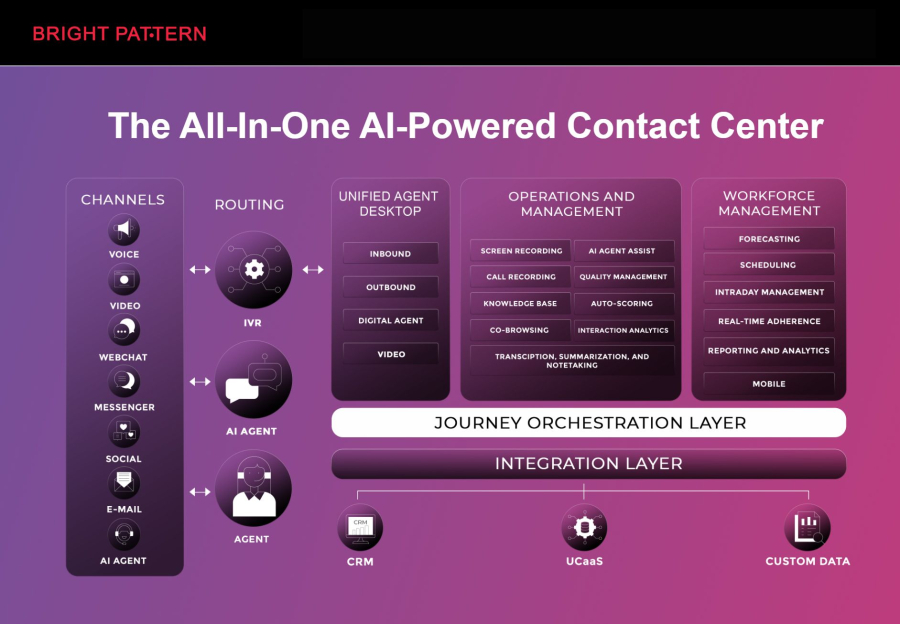
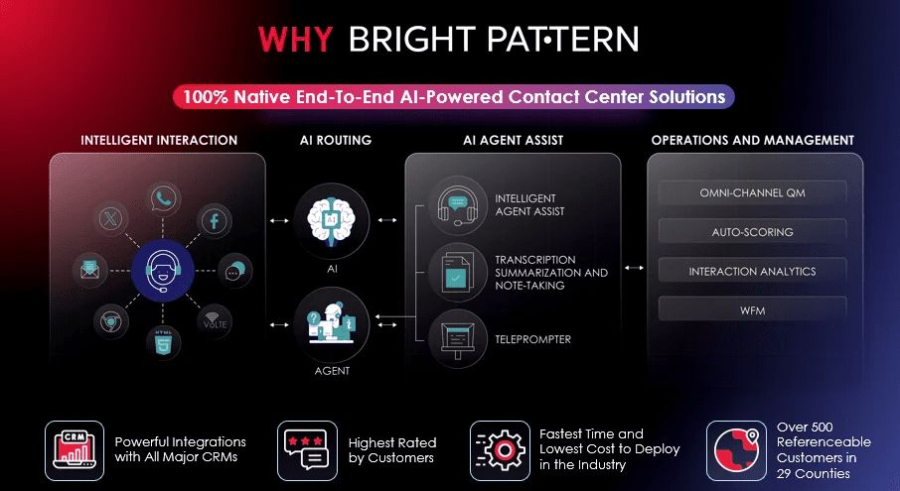
Bright Pattern is a leading provider of call centre AI software, designed to help businesses deliver seamless omnichannel support. Its platform combines AI-powered automation, advanced analytics, and intuitive agent tools to enhance every customer interaction.
Key features include:
- AI-assisted routing to connect customers to the right agent instantly
- Virtual agents for handling repetitive queries, freeing human agents for complex issues
- Omnichannel support across voice, chat, email, and social media
- Real-time analytics and reporting to monitor performance and customer satisfaction
- Easy integration with CRM systems for unified customer data
Bright Pattern’s solution is ideal for companies looking to scale support without compromising quality, enabling faster resolutions and consistent customer experiences.
2. Five9 – Intelligent Cloud Contact Center
Five9 offers cloud-based call centre AI software that focuses on predictive dialing, AI chatbots, and real-time performance management. It integrates well with CRM systems and provides tools for omnichannel engagement.
3. Genesys – AI-Powered Customer Experience
Genesys provides AI-driven call centre solutions, emphasizing automation and workforce optimization. Its platform supports voice, messaging, and social channels, helping businesses maintain consistent interactions.
4. NICE inContact – Advanced AI Contact Center
NICE inContact enables businesses to leverage AI for intelligent routing, virtual agents, and analytics-driven insights. It is designed to improve agent efficiency and customer satisfaction across multiple channels.
5. Talkdesk – Customer Experience AI
Talkdesk’s AI-powered call centre software supports predictive engagement, virtual agents, and workflow automation. It helps organizations provide personalized support while reducing operational costs.
6. 8x8 Contact Center – Omnichannel AI
8x8 combines AI and analytics to optimize customer interactions. Features include intelligent call routing, chatbots, and integrated reporting dashboards for better decision-making.
7. RingCentral Contact Center – AI-Driven Support
RingCentral provides AI tools for call centres, including chatbots, sentiment analysis, and automated workflows. Its platform enables seamless integration across voice, messaging, and email channels.
8. HubSpot Service Hub – AI Support Tools
HubSpot Service Hub offers AI-enhanced automation for ticketing, chatbots, and customer feedback. It is particularly effective for small to medium businesses looking to streamline support operations.
9. Zendesk – AI Customer Engagement
Zendesk incorporates AI to improve ticket management, provide instant answers through virtual agents, and analyze customer interactions for better insights.
10. Salesforce Service Cloud – Intelligent Call Center
Salesforce Service Cloud uses AI for smart routing, predictive analytics, and virtual assistance. Its platform allows businesses to manage customer interactions across all channels in one place.
What Is Call Centre AI Software?
Call centre AI softwareis a set of tools that use artificial intelligence and automation to handle, support, or enhance customer interactions across voice and digital channels. It sits on top of, or alongside, your existing contact centre platform to:
- Answer routine queries using voicebots or chatbots.
- Support human agents with real-time guidance and knowledge suggestions.
- Automate back-office tasks, like logging tickets or updating CRM records.
- Analyse every conversation for insights, quality, and sentiment.
The result is a customer experience that feels faster, smarter, and more tailored, while your team operates more efficiently and with less stress.
Top Business Benefits of Call Centre AI Software
Done right, AI in your call centre becomes a growth driver, not just a cost saver. Here are the benefits organisations usually see first.
1. Shorter Wait Times and Faster Resolution
AI-powered self-service and intelligent routing mean customers spend less time on hold and more time getting what they need.
- Instant self-servicefor simple tasks like order status, password resets, or account balance checks.
- Smart triagethat recognises intent and sends customers to the right agent or bot on the first try.
- Real-time recommendationsthat help agents resolve issues quickly and confidently.
2. Consistent, High-Quality Customer Experiences
AI helps you deliver the same high standard of service across all channels and shifts, regardless of who takes the call.
- Standardised responsestrained on your best practices, tone, and policies.
- Real-time compliance checksthat prompt agents to use required phrases or disclosures.
- Automated quality monitoringso every interaction is reviewed, not just a small sample.
3. Happier, More Productive Agents
Instead of juggling repetitive tasks and searching multiple systems, agents get a streamlined experience powered by AI.
- Automatic call summarisationand note-taking that removes tedious admin work.
- Guided workflowsthat tell agents what to do next based on the conversation.
- On-demand coachingthrough live prompts, scripts, and suggestions.
By taking care of repetitive, low-value work, AI frees agents to focus on empathy, complex problem-solving, and building stronger customer relationships.
4. 24/7 Availability Without 24/7 Staffing Costs
AI assistants can operate around the clock, handling after-hours and peak-time volumes without requiring you to scale your team linearly.
- Always-on supportfor common queries in any time zone.
- Graceful handofffrom bots to humans when complexity increases.
- No missed callswhen demand suddenly spikes or during seasonal surges.
5. Rich Insights From Every Interaction
With AI, your call recordings and chat logs become a powerful source of intelligence instead of unused data.
- Automatic transcriptionof calls for search and analysis.
- Sentiment and intent analysisto understand how customers feel and what they need.
- Trend detectionthat highlights emerging issues, popular questions, or product feedback.
Leaders can use these insights to improve products, refine messaging, and proactively remove friction from the customer journey.
Key Features of Modern Call Centre AI Software
Not all solutions are the same. Leading call centre AI platforms tend to include a combination of these core capabilities.
AI-Powered Self-Service
- Voicebotsthat understand natural speech and respond conversationally over the phone.
- Chatbotsembedded in web, mobile, or messaging channels.
- Smart IVRthat uses natural language instead of complex number-based menus.
Intelligent Routing and Workflow Automation
- Skill-based routingthat matches customers with the best available agent.
- Intent-based routingthat sends different topics to the most appropriate queues.
- Automated workflowsthat trigger actions such as sending emails, creating cases, or updating records.
Real-Time Agent Assist
- Knowledge suggestionsthat surface relevant articles and templates during live conversations.
- Guided scriptsthat adapt based on customer responses and context.
- Compliance promptsto ensure disclosures and policies are followed.
Speech Analytics and Sentiment Analysis
- Conversation transcriptionfor calls in near real time.
- Keyword spottingto flag specific topics, competitors, or phrases.
- Sentiment scoringthat measures how customers feel throughout the interaction.
Quality Management and Coaching
- Automated scorecardsbased on your quality criteria.
- Interaction samplingthat automatically identifies calls worth reviewing.
- Targeted coachingwith suggested improvements for each agent.
Analytics, Reporting, and Dashboards
- Real-time dashboardsfor queue performance, volumes, and service levels.
- Trend reportson customer issues, resolutions, and satisfaction.
- Performance benchmarkingacross teams, channels, and time periods.
How Call Centre AI Software Works in Practice
Although every platform is different, most call centre AI solutions follow a similar lifecycle during each interaction.
- Capture: The system captures the conversation from voice, chat, email, or messaging channels.
- Understand: Natural language processing identifies intent, key entities, sentiment, and context.
- Decide: Business rules and AI models determine the best response or next action.
- Act: The system replies to the customer, assists the agent, or triggers automated workflows.
- Learn: Outcomes are logged, and the models can be refined over time based on feedback and results.
This loop allows your call centre to become smarter with each interaction, continuously improving the experience without requiring massive manual intervention.
High-Impact Use Cases and Success Scenarios
Call centre AI software can support almost every function in a customer-facing organisation. These are some of the most impactful use cases.
Customer Support and Technical Helpdesks
- Instant answers to frequently asked questions.
- Guided troubleshooting for common technical issues.
- Proactive outreach when problems are detected or predicted.
Support teams often report fewer escalations and a smoother handoff between tiers once AI is embedded in their workflows.
Sales and Inbound Enquiries
- Qualification of inbound leads before they reach a sales rep.
- Collection of key information, such as budget or timeline, via conversational flows.
- Consistent pitch delivery using AI-guided scripts and suggestions.
This leads to better lead quality, faster follow-up, and a more consistent customer experience during the buying journey.
Customer Retention and Loyalty
- Detection of at-risk customers based on sentiment and language.
- Personalised offers or save-the-sale scripts triggered in real time.
- Automated follow-ups, surveys, and check-ins after key interactions.
Billing, Payments, and Collections
- Automated reminders for due payments via voice or messaging.
- Secure self-service payment flows with identity verification.
- Tailored negotiation and payment-plan options guided by AI.
Implementation Roadmap: From Idea to Live AI
A structured rollout helps you maximise value and build trust across your organisation. The following roadmap is a practical way to deploy call centre AI software.
- Define clear objectives
Decide what success looks like. Examples include faster response times, higher customer satisfaction, or improved first contact resolution. - Prioritise use cases
Start with high-volume, low-complexity interactions that are easy to automate and measure. - Prepare your data
Clean up call logs, knowledge articles, and FAQs. Good data enables better training and more accurate responses. - Design the experience
Map out conversation flows, escalation rules, and the tone of voice you want your AI to use. - Pilot with a small group
Run a controlled rollout in one region, queue, or channel to gather feedback and refine. - Train and involve agents
Show agents how AI supports them, not replaces them. Offer training and collect input to improve the system. - Scale and optimise
Once the pilot meets your goals, expand to more channels and use cases, continuously measuring and tuning performance.
Key Metrics to Track With Call Centre AI
Measuring the right metrics helps you demonstrate the impact of your AI investment and uncover new opportunities for improvement.
Metric | What It Shows | AI Impact |
Average Handle Time (AHT) | Time spent on each interaction. | AI-guided workflows and automation often reduce AHT while preserving quality. |
First Contact Resolution (FCR) | How often issues are solved in a single interaction. | Better routing and real-time knowledge increase FCR. |
Customer Satisfaction (CSAT) | Customer rating of the interaction. | Faster, more accurate responses usually lift CSAT scores. |
Self-Service Containment | Percentage of queries resolved without human agents. | High-quality bots increase containment while keeping customers happy. |
Agent Utilisation | How effectively agent time is used. | AI automation reduces low-value tasks, improving utilisation. |
Quality Scores | Adherence to scripts, policies, and soft skills. | AI-powered QA can lift scores through targeted coaching. |
Best Practices for Maximising ROI
Successful organisations treat call centre AI as a strategic capability, not just another tool. These practices help you capture its full value.
- Start simple, then scale– Focus on a few high-impact journeys before expanding across the entire contact centre.
- Co-design with agents– Involve frontline teams in designing prompts, flows, and triggers. They know your customers best.
- Keep humans in the loop– Ensure easy escalation paths and clear ownership for complex or sensitive cases.
- Continuously train and update– Refine models, add new intents, and refresh knowledge regularly.
- Align with your brand voice– Make sure AI responses reflect your tone and values, from empathy to professionalism.
How to Choose the Right Call Centre AI Software
Selecting the right platform is easier when you know what to evaluate. Consider these dimensions when comparing vendors and solutions.
- Capabilities– Does it cover your priority use cases, channels, and languages?
- Ease of integration– How well does it work with your existing contact centre, CRM, and ticketing tools?
- User experience– Is it intuitive for supervisors, admins, and agents to use and configure?
- Customisation and control– Can you tune flows, rules, and responses without extensive coding?
- Scalability– Will it support higher volumes, new regions, or additional brands as you grow?
- Security and compliance– Does it meet your requirements for data protection, audits, and industry regulations?
- Support and success services– Does the provider offer onboarding, training, and optimisation support?
The Future of AI in Call Centres
Call centre AI will continue to evolve, becoming even more context-aware, proactive, and tightly integrated with the rest of the business. Some trends to watch include:
- Hyper-personalisation– Tailored experiences based on history, preferences, and real-time context.
- Proactive service– Reaching out to customers before they contact you, based on predictive signals.
- Unified AI across channels– A single intelligence layer powering voice, chat, email, and in-app support.
- Deeper collaboration tools– AI that not only assists agents but also helps supervisors manage teams in real time.
Conclusion: Turning Your Call Centre Into a Strategic Advantage
Call centre AI software gives you a powerful way to modernise customer service, boost satisfaction, and empower your teams. By combining intelligent automation with human empathy, you can handle higher volumes, resolve issues faster, and gain insights that drive better decisions across the business.
Whether you are aiming to reduce operational costs, support growth, or simply deliver a standout customer experience, well-implemented AI in your call centre can become a lasting competitive advantage.
